

SIP Panels Toronto: Are Structural Insulated Panels Worth the Investment?
As Toronto moves toward stricter energy efficiency standards (OBC Tier 3 and beyond), homeowners and architects are looking beyond traditional 2×6 stud walls. SIP panels Toronto projects are becoming increasingly popular as Structural Insulated Panels offer one of the most discussed—and misunderstood—technologies in residential framing. They promise a tighter, warmer house, but they come with a higher initial price tag.
Are SIP panels a smart investment for a Toronto home, or just an expensive trend? The answer depends on your priorities: long-term operating cost vs. short-term construction budget. In this guide, we break down everything GTA homeowners need to know about SIP panels Toronto construction.
What Exactly is a SIP Panel?
Think of a SIP panel as a high-performance sandwich. It consists of a rigid foam core (typically Expanded Polystyrene or EPS) laminated between two layers of Oriented Strand Board (OSB). Unlike a traditional stud wall, which is 25% wood and 75% empty space (insulation), a SIP wall is solid and continuous.

Typical SIP construction shows the rigid foam core sandwiched between interior and exterior OSB sheathing—providing continuous insulation without thermal bridging.
The Analogy: A stud wall is like a puffy winter coat with a few thin spots (thermal bridges). A SIP panels Toronto wall is like a high-density sleeping bag—consistent warmth everywhere.
The Economics: Upfront Cost vs. Long-Term ROI
Let’s address the elephant in the room: Cost. In the GTA market, building with SIPs typically costs 10-20% more for the shell package (materials + installation) compared to advanced stick framing.
However, a proper financial analysis looks beyond the framing line item. The premium is offset by:
1. Labor Speed
SIP walls and roofs go up significantly faster than stick framing. A crew can dry-in a SIP home in days rather than weeks. For Toronto projects where carrying costs (interest on construction loans) are high, this speed saves real money.
2. Eliminated Insulation Trade
The insulation is already in the panel. You don’t need to schedule—or pay—a separate insulation crew to fill the walls. The electrical rough-in is still required, but the insulation step is essentially complete the moment the panel is installed.
3. Reduced HVAC Sizing
A SIP home is exceptionally airtight. We routinely see blower door test results below 1.5 ACH50 (Air Changes per Hour). Because the house loses so little heat, you can often downsize your furnace and air conditioner, saving several thousand dollars on mechanical equipment.
4. The Payback Period
With Toronto’s rising hydro and gas rates, the energy savings from a SIP envelope can offset the 10-20% premium within 5-8 years. After that, it’s pure savings and superior comfort.

SIP panels arrive on site pre-cut with window openings, significantly reducing on-site framing labor and eliminating construction waste in Toronto’s tight urban lots.
Why SIPs Are a Perfect Fit for Toronto’s Climate
Toronto’s climate is hard on houses. We swing from -20°C dry cold to +30°C humid heat with freeze-thaw cycles in between.
Eliminating Thermal Bridging
In a standard 2×6 wall with R-20 batts, the wood studs act as “thermal bridges.” Wood has an R-value of only about R-1 per inch. In winter, the studs conduct cold from the outside to the inside, creating cold spots on your drywall where condensation can form (and eventually mold). SIPs eliminate this because the foam core is continuous.
Air Tightness
Toronto homes lose a significant portion of their energy through air leaks—around electrical outlets, rim joists, and where walls meet floors. SIP panels Toronto construction creates a nearly monolithic shell that drastically reduces these drafts.
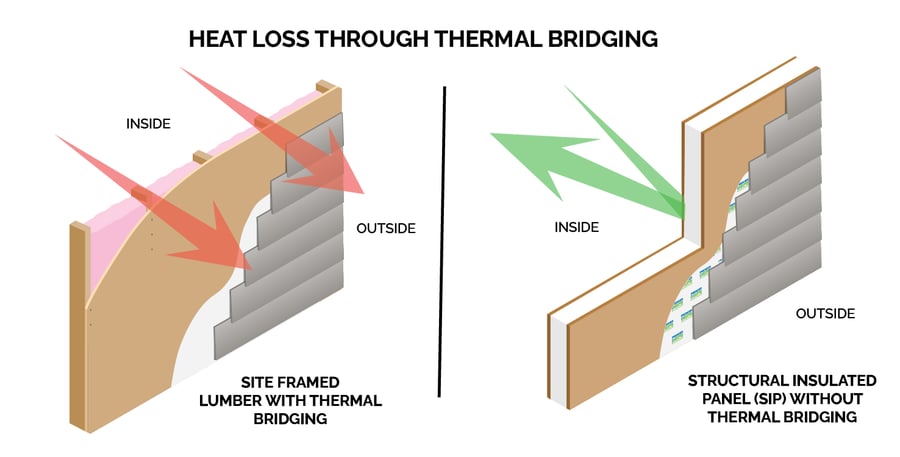
Unlike traditional framing where wood studs create thermal bridges (red/orange heat loss areas), SIP panels provide a continuous insulation layer for superior Toronto winter performance.
Not Just for Walls: SIP Roofs and Floors
While often thought of for walls, SIPs are incredibly effective for roof construction. A SIP roof allows you to use the attic space as a conditioned “hot roof” assembly without messy spray foam or venting baffles. This is ideal for Toronto homes where every square foot of real estate is precious, allowing you to turn a dusty attic into a clean, conditioned storage or living loft.

Crane setting SIP roof panels allows for rapid dry-in and creates a conditioned attic space without traditional venting—perfect for maximizing usable square footage in GTA homes.
The Toronto-Specific Challenge: Moisture and Detailing
SIPs are unforgiving of water leaks. Because the OSB skins are wood, they must be protected from bulk water. In Toronto’s wet springs, this means the panel joints must be taped meticulously and flashed correctly. Building Science Corporation recommends specific rain-screen detailing over SIPs to ensure the wall can breathe and dry outward.
Hi Quality Homes has specific protocols for rain-screen detailing over SIPs to ensure the wall can breathe and dry outward, preventing the long-term rot issues that can plague poorly installed SIP envelopes.
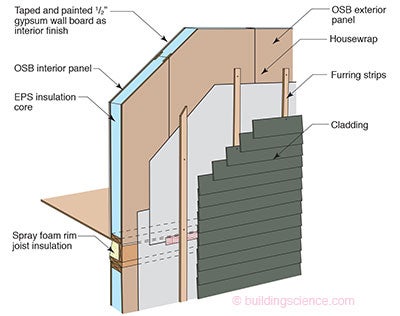
Proper SIP wall assembly includes rain-screen detailing, housewrap, and spray foam rim joist insulation to manage Toronto’s wet spring climate and prevent moisture damage.
Is SIP Right for Your Project?
Custom Modern Builds: Yes
If you are building a contemporary home with large open spans and a desire for ultra-efficiency, SIPs are a top-tier choice for SIP panels Toronto construction.
Complex Additions: Maybe
SIPs work best on simple geometric forms. If your addition is a complex maze of jogs and cantilevers, the engineering and factory cutting fees for SIPs can erode the cost benefit. A hybrid approach (SIP roof on stick-framed walls) is often the sweet spot.
Heritage Restorations: Rarely
Integrating rigid SIP panels with the wavy, settled framing of a 100-year-old Toronto home is extremely difficult.
Conclusion: SIP Panels Toronto Investment Analysis
For homeowners prioritizing long-term energy efficiency, faster construction timelines, and superior indoor comfort, SIP panels Toronto construction represents a smart investment despite the 10-20% upfront premium. The 5-8 year payback period, combined with reduced HVAC costs and eliminated insulation trades, makes SIPs particularly attractive for custom builds in the GTA.
Curious if SIP panels make financial sense for your specific lot? Request a custom framing budget comparison from Hi Quality Homes.
Related Resources: